top of page
Labyrinths
The Labyrinths series began in 2009 and remains complementary to the research on the Ciclotramas. The lines of these labyrinths do not have a single viewpoint, but are perspectives within perspectives. An attempt to “see everything” or “unite everything.” Space would be a trap, as a labyrinth can be.
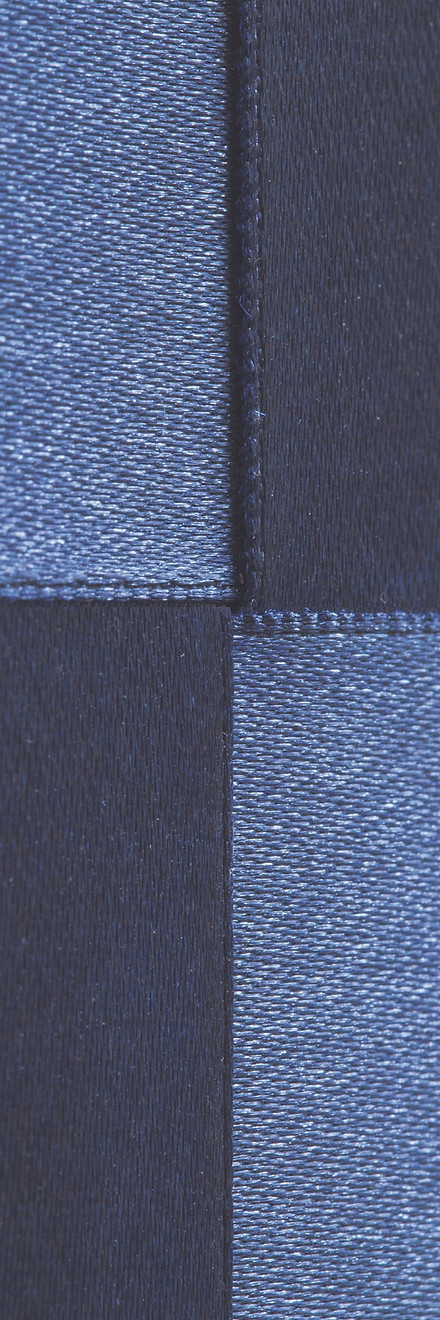
Materially, the process comes to life through satin ribbons of varying widths and colors, stretched over the edges of the stretcher frame. In the end, a walnut-based darkening extract reduces the sheen and brings the tones together, revealing spatial relationships—as if the drawing needed shadow to fully reveal itself.


Labyrinths/Maze
The research that Janaina Mello Landini develops brings together, in parallel, two series that, at first, test distinct paths between order and indeterminacy.
The Ciclotramas start from a clear principle of construction and arrive at organic and unpredictable results; the Labirintos start from a free, almost intuitive configuration, but resolve themselves through a precise technical and spatial rigor.
Even so, both begin from the same question: how to organize space without reducing its complexity, and how to maintain the openness of thought without losing the legibility of form.
For the Labirintos, the artist’s procedure can be understood as an exercise in shifting the gaze. Instead of starting from objects — walls, buildings, furniture — she focuses on the intervals between them. Paths, passages, voids.
By imagining possible routes within a known space — a house, a block — the drawing begins to emerge as a network of trajectories. What is then revealed is the unbuilt space — the interstice — as an active field of circulation.
The artist tensions the use of geometry by creating a kind of almost classical perspective, which seems to converge toward a centrality. However, this center is unstable, because the point of view is multiple. The result is not a faithful representation of an existing space, but a construction that combines different points of view, nested within one another, creating a broad and deep image. The gaze shifts continuously, as if moving through the drawing from within.
Materially, this process is realized with satin ribbons of different widths and colors, precisely tensioned along the edges of the stretcher. The drawing is constructed
through the crossing of the ribbons, which pass alternately over and under the plane. The final application of a darkening walnut-based extract reduces the shine of the ribbons and brings the tonal values closer together, allowing the spatial relationships to become more visible, as if the drawing required a certain shadow in order to fully reveal itself.
bottom of page